







David Maister - Professional Business, Professional Life

jump to menu jump to content
David Maister - Professional Business, Professional Life
David's ResourcesAbout David
NEW! Browse my materials by topic of interest:StrategyManagingClient RelationsCareersGeneral

Passion, People and Principles

post # 296 — Tuesday, January 30, 2007 — a Managing, Careers post

20 Bad Workplace Habits

Marshall Goldsmith is a famous executive coach, who has worked with more than 80 CEO’s in the world’s top corporations. He has a fabulous new book out called What Got You Here Won’t Get You There. Actually, the title is not very descriptive, but the subtitle says it all: 20 workplace habits you need to break. It’s a content-rich, well-written book.
 

While Goldsmith warns against self-diagnosis, I found the list incredibly helpful (even though I am not and never will be a CEO.) The practical, real world advice he provides for conquering these bad habits is immensely useful. Here’s his list of bad habits:

  1. The need to win each time
  2. The overwhelming desire to add our two cents to every discussion
  3. The need to pass judgment on others
  4. Needless sarcasm and cutting comments
  5. Starting with “no”, “But”, “However”
  6. Need to show how smart we are
  7. Speaking when angry
  8. Negativity: the need to share negative thoughts even when not asked
  9. Withholding Information
  10. Failing to Give Proper recognition
  11. Claiming credit we don’t deserve
  12. Making excuses
  13. Clinging to the past
  14. Playing favorites
  15. Refusing to express regret
  16. Not listening
  17. Failing to express gratitude
  18. Punishing the messenger
  19. Passing the buck
  20. An excessive need to be “me”: exalting our faults as virtues simply because they’re who we are

Read the book. You’ll learn a lot about yourself, and how to improve (slowly.)

As a way to get our discussion going on this blog, let me ask all of you two questions about your bosses (not about you, but your bosses.)

(a)   

Which of Goldsmith’s 20 bad habits would you say is the most damaging?

(b)  

Which do you think are the most common?


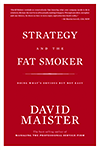
Order your copy of David Maister’s new book, Strategy and the Fat Smoker today!

print this post | add to del.icio.us
trackback url: http://davidmaister.com/trackback.php?id=319

18 Comments

Greg Krauska said

http://changeagentgroup.typepad.com

David, I believe what is most damaging is not the actions themselves, but the person's stance that creates these actions.

A great lesson from improv is the idea of saying "yes" first to new ideas.  When one actor tries to steer the direction of an improv scene, ignoring the "gift" presented by the other actors, the rhythm, the humor and the chemistry immediately break down. 

Great conversation, effective meetings, successful cultures almost always have "Yes, and . . . " somewhere in their foundation.

posted on Tuesday, January 30, 2007

peter vajda said

Actually, I think this "bad workday habits" post points directly to your Sunday post and the Islamic message: "Very often, we are concerned about our own welfare and the souls of others. It would be better if we would be more concerned about our own souls and the welfare of others."

This type of "finger pointing" and judging others' "bad workday habits" in the interest of what? "fair anlaysis of another" points to the first part of the Islamic saying...that is, it's easier to "fix" and "take care of" someone else  by pointing out their foibles (their soul) and be concerned about my own welfare (feeling safe by diverting attention away from me), than the reverse. 

While Goldsmith warns against "self-diagnosis", I hope he doesn't warn against "self-reflection".  As I belong to the "there's no such thing as compartmentalization" school of thought, and in keeping with the lesson in the Islamaic saying (looking at our own souls), I might suggest printing out this list and giving it to our spouses, partners and children and in a quiet setting ask them to respond whether I manifest any of these habits, and, on a scale of 1-10, which ones are most common and which are most damaging to a healthy relationship. I would bet $1.00 that what he/she/they say with respect to who I am and how I am at home reflects who I am and how I am at work. "Know thyself", for me, is the first tenet of creating healthy, honest and mutually respectful relationships at work...and it seems, at least to me, it is with that Islamic saying as well.

It's what's underneath the behaviors that's important to explore. Often, in my experience, one's ego needs for control, recognition and security are often the drivers and root causes for such "bad workday habits."

posted on Tuesday, January 30, 2007

David (Maister) said

Actually, Peter, Goldsmith also suggests that getting feedback is the key. I just turned it around for the sake of our blog discussion. Of course, it's really about US, but it's still interesting I hope to ask which of these are most damagingly displayed by THEM? 

posted on Tuesday, January 30, 2007

Mike DeWitt said

http://spookyaction.blogspot.com

David,

I would say that the most damaging is "Punishing the messenger".  It cuts off communication and candor and WILL drive behavior changes in many staffers that will isolate the manager.

As for the most common, I've seen all of them in action, but "Passing the buck" is probably the most prevalent.

Mike

posted on Tuesday, January 30, 2007

Greg Krauska said

http://changeagentgroup.typepad.com/

 . . . and to answer your question, David, #5 is the most damaging.  Negating reduces dialog, limits options and is the antithesis of "yes, and . . ."

posted on Tuesday, January 30, 2007

Mark Shead said

http://www.productivity501.com

It is a combination of several of his points, but one of the most common and damaging practices I've seen is when someone isn't honest about mistakes.  If the boss never admits a mistake it is hard for an organization to learn from the mistake.  I've seen some people try to call the mistake a success. This type of behavior keeps the people they direct from learning to avoid the same type of mistake in the future.

Here is an exerpt from an article showing an example of this type of behaviour:

There was a large organization that was beginning to saturate the market for its services at a particular location. The leadership decided that expanding to a branch office was the right decision. They leased a building, renovated it and began operations. It was soon apparent that there was a problem with the cost structure at the branch office. Many of the methods of doing business at the main headquarters were very inefficient when scaled down to the size of the branch office. To make matters worse, the branch office didn’t attract many new customers. Most of the clients were existing customers who had previously done business at the headquarters building.

After a few years the main headquarters built a bigger building and the branch office was shut down. However, the organization told people that the plan had always been to shut it down once a larger headquarters was built. While much of the staff knew that this wasn’t the case. By trying to hide the fact that the branch office had been a failure, they were unable to learn from the failure in a way that could help enable successes in the future. Without this opportunity to learn, it is very likely that any future branch offices will suffer a similar demise—assuming that the organization even attempts another expansion.

posted on Tuesday, January 30, 2007

Pawel Brodzinski said

http://managee.blogspot.com

I have to be very happy employee. I don't find my current boss being notoriuos on any of above points. I can hardly point several violations of a couple of them. 

However, my previous boss was violating most of them. In that case I'd say the most damaging was a need to win every time. In discussion, in business, in virtually everything. In vast majority of cases any discussion etc was a waste of time. My favorite quote from him is "It's like that, because it's like that."

The most common of his habits was not listening. He wasn't listening anyone except himself, one of his fellow directors and (as it's said) his wife. Even his assisant said that any dialogue with him was simply impossible.

posted on Tuesday, January 30, 2007

Brandon Hull said

http://www.salesteamtools.com

Hard to select a "most worst" habit here, but I'd agree with Pawel and say it's not listening, #16. 

Not listening is a catalyst to the other bad behaviors, in my opinion. It kills client relationships, destroys team dynamics, and breeds cynicism and selfishness in workplaces (and in people). 

posted on Tuesday, January 30, 2007

Tom said

http://machete.wildjobsafari.com

David -

Excellent post.  Intersting responses, too.

If I could only pick two "worst offenders," they would #7 and (to join Pawel and Brandon) #16.  Both are communication issues: speaking in anger leads to incorrect language, while not listening cuts communication in half.  

Tom
The Daily Machete

posted on Tuesday, January 30, 2007

Stephen Downes said

http://www.downes.ca

Generally pratcical advice for oneself, but when propagated in the workplaces verges on thought control.

For example, the criticism of 'Starting with “no”, “But”, “However”' is more of an attempt to change your language than it is of fostering a positive workplace attitude. The purpose of changing the language, of course, is to encourage staff to think of all initiatives as consisting entirely of good points. This is not true, of course - and the use of the word 'but' is helpful when distinguishing what is worth keeping and what is not.

How often have I said, "I agree with you. We all want the organization to function more smoothly as a unit. But executing dissenting staff is not the best wat to get there."

posted on Wednesday, January 31, 2007

Bayram Annakov said

http://bayramannakov.wordpress.com/

I think most of these habits can be grouped into "Not caring about others". But one thing that I would like to add is: giving promises and not fulfilling them.

The most common case in my work: one of employees wants to retire and manager starts to "care about employee": s/he talks about carreer objectives, bonuses, salary rates, training & etc. But, in fact, this is done just to avoid losing employee. Some time later, employee understands that manager won't fulfil promises and quits the job with a very bad perception of manager.

posted on Wednesday, January 31, 2007

Wally Bock said

http://blog.threestarleadership.com

I nominate the toxic combination of the necessity to win every time and killing the messenger.  When those combine in someone in a power position they cut off both information and cooperation.

posted on Wednesday, January 31, 2007

David Kirk said

www.twentythirdfloor.co.za

My initial call was "not listening", reading the other comments made me think about the options to look for themes rather than individual options.

How about Ego? Doesn't that sum up many of these, and drive the others? I don't count myself entirely innocent here either, to my embarrassment.

Having "themes" which cover the principles, or quotes which outline a broad idea can help to get the underlying message across, but the specific points help to focus the mind of the sorts of things we (they?) do. It's all too easy to say I agree that the theme is bad, but I certainly don't act in those ways. The specific points are more difficult to dodge, and thus are possibly more likely to result in change.

posted on Wednesday, January 31, 2007

Patrick J. McKenna said

www.patrickmckenna.com/blog

Greetings David:

Interesting that you should mention Goldsmith's latest text. I've read the book and thought it quite good. Coincidental to reading through his twenty habits, I'd been doing a bit of my own research on this subject. I respectfully think one could combine a number of the twenty he mentions, and I also think that there are a number that he has missed. For instance:

Some Other Behavioral Problems of Leaders:
 
• Acting Vindictive & Vengeful.                                                              
All of us experience hurt and injustice; but not all of us keep meticulous track of who did us wrong and how we can even up the sore. These leaders have a motto that reads ‘Don’t get mad, get even.’ These people ‘quietly’ act as if they are recounting slights and grievances they’ve carried for years, mull over every offensive word or deed they have encountered, and are now deliberately concocting plans for retribution.
 
• Always Pushing Workaholic.
For these leaders, their work is an intoxicant. They cannot live without it; they are addicted.  They are constantly self-driven to do more, much more than is expected or even needed. Their compulsions spill over onto others. Workaholics often grumble that their colleagues aren’t pulling their weight. They cannot settle for being simply ‘good enough’ and in almost any project they will single out a small detail that isn’t quite perfect. Their standards are often demanding and unrealistic.
 
• Procrastinates.
Throughout the personal career of most professionals, success has hinged on analyzing situations, covering all bases, and not making mistakes. When those same analytical traits are brought to managing a firm they can contribute to over-analysis, indecision, and ultra-conservative behavior – hampering entry into new markets, the introduction of a new service, or fully implementing important growth projects.
 
• Avoids Conflicts At All Costs.
More common than one might expect, is the managing partner who prefers to remain on the sidelines, prefers to isolate herself behind an air of neutrality, doesn’t want to take a stand for fear of being criticized; and avoids engaging in any contentious discussions. They are consumed by the question, ‘What will people think?’ These leaders permit differences among partners to go unresolved, allowing for an environment of simmering animosity. They rationalize that intelligent professionals should be able to have honorable differences of opinion and hope that it will all go away.
 
• Domineering and Controlling Presence.
Some leaders pay little attention to their impact on others. In their daily interactions with partners, they rarely allow others to assume the spotlight, dominate to the point where people are hesitant to offer fresh information, and generally suck the enthusiasm out of any meeting they attend, through their continual talking.  They desperately try to retain control, refuse to delegate, and act as if anyone else’s preferences were of little consequence.
 
• Blindly Insensitive To Others.
This is the leader who is prone to stepping on another partner’s toes and doesn’t seem to know it; hurts people’s feelings and does it quite innocently. This individual will often display a complete lack of tact as they blurt out critical comments or share a rumor they’ve just heard with little sensitivity to the emotional consequences.
 

I have a session scheduled next week with a group of managing partners where I had intended to pose similar questions to the two you asked. I'll keep you advised of what I learn.

posted on Thursday, February 1, 2007

mary wynne-wynter said

http://www.redshifthome.com

Thank your for posting this list.  Just reading it was like nails on a chalkboard.  

I think the most damaging are:
Failing to Give Proper recognition
Claiming credit we don’t deserve
Both are team, motivation and ideas killers.

I agree with the comment that most of these bad habits are related to ego.  I would also add that they are related to attachment to knowledge, or the accumulated mental and psychological content that allows no space for change.

As a change facilitator, I work with people to help them become aware of their voice of knowledge/ego and help them intend to release their identification with it.  Once they start to do that, the bad habits start to resolve.

posted on Monday, February 5, 2007

Chuck said

4, 8 and 10 are the most damaging in my mind.  Those actions severely degrade the morale of an organization and unfortunately they seem to be the most common in mine.

posted on Wednesday, February 14, 2007

jill said

Where does this kind of behavior belong inside a workplace to begin with???

I feel alot of companies would or can benefit if they would decide to put all of their employees through a Behavioral Mgmt. Course as a condition of employment or future employment. How can we expect people to behave professionally inside a workplace when they don't know how to act? Most companies have handbooks - that explicitly point out what isn't tolerated - so why are these behaviors condoned inside of the workplace to begin with?

posted on Friday, February 23, 2007

Lawrence said

http://www.managecontroltime.com

David,

Item 14, playing favorites is common in a lot of organization and is very bad habit if the person does not consider all pros and cons that will affect the organization. Not listening (Item 16) and passing the buck are 2 time wasters and create a lot of resentment to staffs and colleagues.

Lawrence


posted on Friday, May 9, 2008


Post a Comment

Note: This blog uses a 2-click comment system to combat spam. After you submit your comment below, you will be prompted to click a second button to complete the posting process.


11 Trackbacks

trackback url: http://davidmaister.com/trackback.php?id=319

url:

http://www.salesteamtools.com/2007/01/30/bad-wo...

blog:

SalesTeamTools

title:

Must-read list of bad workplace habits

excerpt:

What an important post/link/reference from David Maister regarding Marshall Goldsmiths new book, What Got You Here Wont Get You There.


url:

http://creatingabetterlife.net/2007/02/04/the-p...

blog:

Creating a Better Life

title:

The Personal Development Carnival - February 4, 2007

excerpt:

Welcome to the February 4, 2007 edition of the Personal Development Carnival! I went light on the commentary this week… sorry, but I’m extremely distracted. Enjoy the carnival! Mark McManus presents How To Know Your Life Is Purpose Drive...


url:

http://smartcoolrich.com/2007/02/03/capital-cha...

blog:

SmartCoolRich

title:

Capital, Charisma, & Cojones: Volume 1

excerpt:

David Maister outlines the 20 Bad Work Habits - and he gets some very insightful comments from his readers


url:

http://www.BryanCFleming.com/2007/02/07/persona...

blog:

Bryan C. Fleming

title:

Personal Growth Carnival - 28th Edition

excerpt:

It’s been another big week with almost 40 quaility submissions.  Next week will be the 29th edition.  The theme will be “The Power of Focus”.  Anyone who posts their best article about ”The Power of Focus” will be pos...


url:

http://www.theprobabilist.com/carnival-of-impro...

blog:

The Probabilist . com

title:

Carnival of Improvement 03

excerpt:

20 Bad Workplace Habits (277) by David Maister enlists damaging habits that cause relationships and meetings in (work) environments to go sour. First see to it that they arent part of your behaviour and then see if you can address and heal them in o...


url:

http://www.crmlowdown.com/2007/02/carnival_of_c...

blog:

CRM Lowdown

title:

Carnival of Customer Service #4

excerpt:

David Maister presents 20 Bad Workplace Habits posted at Passion, People and Principles. Improve your customer service by making sure you don't exhibit these bad habits to your customers.


url:

http://www.tomnixon.co.uk/2007/02/faults_as_vir...

blog:

Business for enjoyment's sake

title:

Faults as virtues

excerpt:

David Maister shares this list of 20 bad workplace habits from a book by Marshall Goldsmith. The first 19 look pretty sensible to me, but number 20 is curious:An excessive need to be “me”: exalting our faults as virtues simply


url:

http://www.vervecoaching.com/?p=87

blog:

Verve Coaching

title:

Carnival of Powerful Living - February 19, 2007

excerpt:

David Maister presents 20 Bad Workplace Habits posted at Passion, People and Principles, saying, Ditch these bad habits to become more effective.


url:

http://www.lucasmcdonnell.com/business-technolo...

blog:

Uncommon Knowledge.

title:

Business, Technology and Knowledge 0.6.

excerpt:

Welcome to the February 26, 2007 edition of Business, Technology and Knowledge. We’re featuring a post today from GameProducer.net which tells us why 80 Percent of Companies Won’t Fail Within 5 Years posted at Game Producer. The article ...


url:

http://www.balancedlifecenter.com/182-personal-...

blog:

Balanced Life Center

title:

Personal Development Carnival 03-04-07

excerpt:

Welcome to the Personal Development Carnival! I’m always so excited to host this carnival. I’m read 50+ personal development feeds daily, and I still manage to find a new blogger when I host. It’s also inevitable that I find a profoun...


url:

http://passiveincome.typepad.com/imrc/2007/03/w...

blog:

Internet Marketing Resource Center

title:

what it takes to be successful online - March 22, 2007

excerpt:

Welcome to the March 22, 2007 edition of what it takes to be successful online. Brandon Peele presents Landmark Advanced Course posted at GT. Vadim presents How To Find A Certain Group Of NON-english Speaking People And How To Sell


 Blog RSS

(about RSS)

sign up here to receive blog posts by email


Add this blog to my Technorati Favorites!

(about Technorati)

Blog Archive

As my blog has grown extensively over the past year, I've created a new dynamic blog archive for those of you who may be looking to dig through the earlier discussions.

Due to the ever-expanding nature of the conversation here, I’ve created this indexing system to help those of you that may be looking for earlier conversations. Click on any of the four main topics below to see their subcategories, and click the subcategories to see the relevant blog posts. Click here or on the x in the top corner at any point to return to the main blog page.

This is a beta version of the interface, and we plan to develop a more refined catgorization scheme but thought this early version would be useful.

Recent Comments
Recent Posts
Popular Posts